
FAIL. SAIL. TAIL. Are you paying attention?

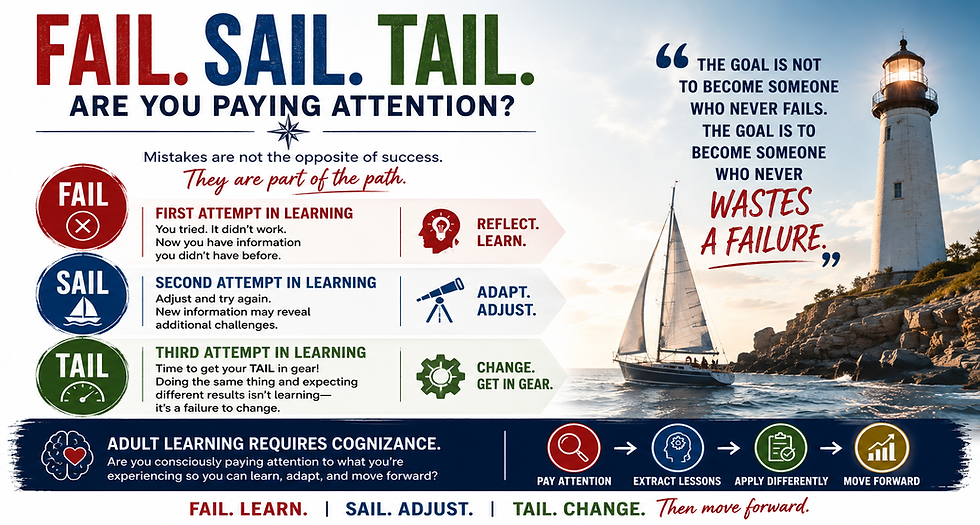
FAIL. SAIL. TAIL. Are You Paying Attention?
You made a mistake. Now what? For many of us, the immediate response is frustration, embarrassment, disappointment, or even defensiveness. We ask ourselves, “How did I let that happen?” But perhaps there is a better question: “What did I just learn?”
Mistakes are part of being human. Learning from them, however, requires more such as: awareness, intentionality, and the willingness to pay attention. When a mistake is made, maybe it can be seen as a F.A.I.L. which is, a First Attempt In Learning.
What if we stopped seeing FAIL as an ending and started seeing it as our First Attempt In Learning? You tried something. It did not produce the outcome you expected. Good. Now you have information you did not have before.
Failure becomes valuable when we examine what happened, recognize what we missed, and determine what we will do differently. The first attempt gives us experience. Reflection turns that experience into learning. SAIL — Second Attempt In Learning
So, you adjust and try again. Welcome to your SAIL: Second Attempt In Learning.
The second attempt should be different because you should be different. You now know something you did not know the first time. But what if it still does not work? Pay attention.
Perhaps there are additional challenges you did not recognize. Maybe your original assumption was wrong. Maybe the environment changed. Maybe your approach needs further adjustment. That does not necessarily mean stop. It means learn again.
A sailor does not control the wind, but they continually adjust the sail based on the conditions around them. We must learn to do the same. TAIL — Third Attempt In Learning
Now we arrive at TAIL: Third Attempt In Learning. And this is where I would tell you—with a little humor—it may be time to get your TAIL in gear! By the third attempt, the question should no longer be simply: “Why isn't this working?”
The better question is: “What am I failing to learn?” There is a familiar saying that describes insanity as doing the same thing repeatedly while expecting a different result.
Whether or not we call that insanity, repeatedly experiencing the same outcome without changing our thinking, behavior, assumptions, or approach is certainly a failure to learn.
And that may be the greater problem.
As adults, we are constantly accumulating experiences—but experience and learning are not the same thing. We can experience something ten times and learn very little if we are not paying attention. Learning requires us to be cognizant: consciously aware of what is happening, what we are doing, how others are responding, what outcomes we are producing, and what those outcomes are trying to teach us.
That means after a mistake, we should ask:
What happened?
What did I contribute to the outcome?
What did I fail to recognize?
What have I learned?
What will I intentionally do differently next time?
Because the goal is not to become someone who never fails. The goal is to become someone who never wastes a failure.
FAIL. Learn.
SAIL. Adjust.
TAIL. Change.
Then move forward. The question is not whether you will make another mistake. You will.
The question is: Are you cognizant enough to recognize what the mistake is trying to teach you?



Comments